

Why Does Tile Grout Crack, and When Is It Serious?
Tile grout cracks because grout is rigid but the tile bed beneath it moves. Small hairline cracks in the grout lines are usually shrinkage from curing, or slight seasonal expansion and contraction. Cracks that run straight across several tiles, that keep widening, or that show up next to cracked tiles themselves usually mean something is moving underneath. That kind of cracking is a signal, not just a nuisance.
What Ordinary Grout Cracking Looks Like
Most grout cracking is cosmetic. Grout is a cement-based product, and it shrinks slightly as it cures over the first 24 to 72 hours. Hairline cracks under 1/16 inch, scattered randomly along grout lines, usually fall into this category.
These cracks tend to appear near tile edges rather than running straight through a field of tiles. They do not widen from one season to the next. They do not pair with cracked tile bodies. A yearly regrout of a few joints, or simple caulking at movement joints, generally solves it.
Sanded grout, used in joints wider than 1/8 inch, resists this kind of shrinkage cracking better than unsanded grout. Bathrooms and kitchens finished with unsanded grout in wider joints are the ones we see calling back first.

Signs the Cracking Means Something Bigger
Some patterns are worth taking seriously. Watch for these:
- A crack that runs in a straight line across four or more tiles, not just along one grout joint.
- Cracks wider than 1/8 inch, or ones that keep opening over a few months.
- Grout cracking paired with cracked or hollow-sounding tile nearby.
- Doors that stick in the same season the cracking appears.
- A slight ridge or dip you can feel underfoot near the crack line.
Any one of these on its own is worth a look. Two or more together usually means the subfloor or slab beneath the tile is moving, not just the grout.
Grout Crack Patterns and What They Usually Mean
| Pattern | Typical Width | Likely Cause | What To Do |
|---|---|---|---|
| Random hairline, scattered | Under 1/16 in | Normal cure shrinkage | Regrout affected joints |
| Straight line across multiple tiles | 1/16 to 1/8 in | Subfloor deflection or joist movement | Have the subfloor checked before regrouting |
| Crack plus cracked tile body | 1/8 in or wider | Tile bed failure or slab crack telegraphing up | Investigate substrate; tile may need replacement |
| Cracking along a wall line | Varies | Missing movement joint at perimeter | Add a flexible caulk joint |
| Cracking near a plumbing wall | Varies, often widening | Slow leak softening subfloor or slab moisture | Check for moisture before any regrouting |
Check This First, Then This
When a customer calls about cracked grout, we work through the same short sequence.
1. Measure the crack
Anything under 1/16 inch and scattered is usually cosmetic. Anything approaching 1/8 inch gets a closer look.
2. Trace the pattern
Follow the crack. Does it stop at one tile, or does it run straight through several? A straight run across tiles almost always traces back to something structural underneath, not the grout itself.
3. Check the tile, not just the joint
Tap nearby tiles lightly. A hollow sound means the tile has debonded from the substrate. That is a different repair than regrouting.
4. Look around the room
Sticking doors, a new gap at the baseboard, or a crack in drywall near the same wall all point toward foundation or framing movement rather than a grout problem.
5. Rule out moisture
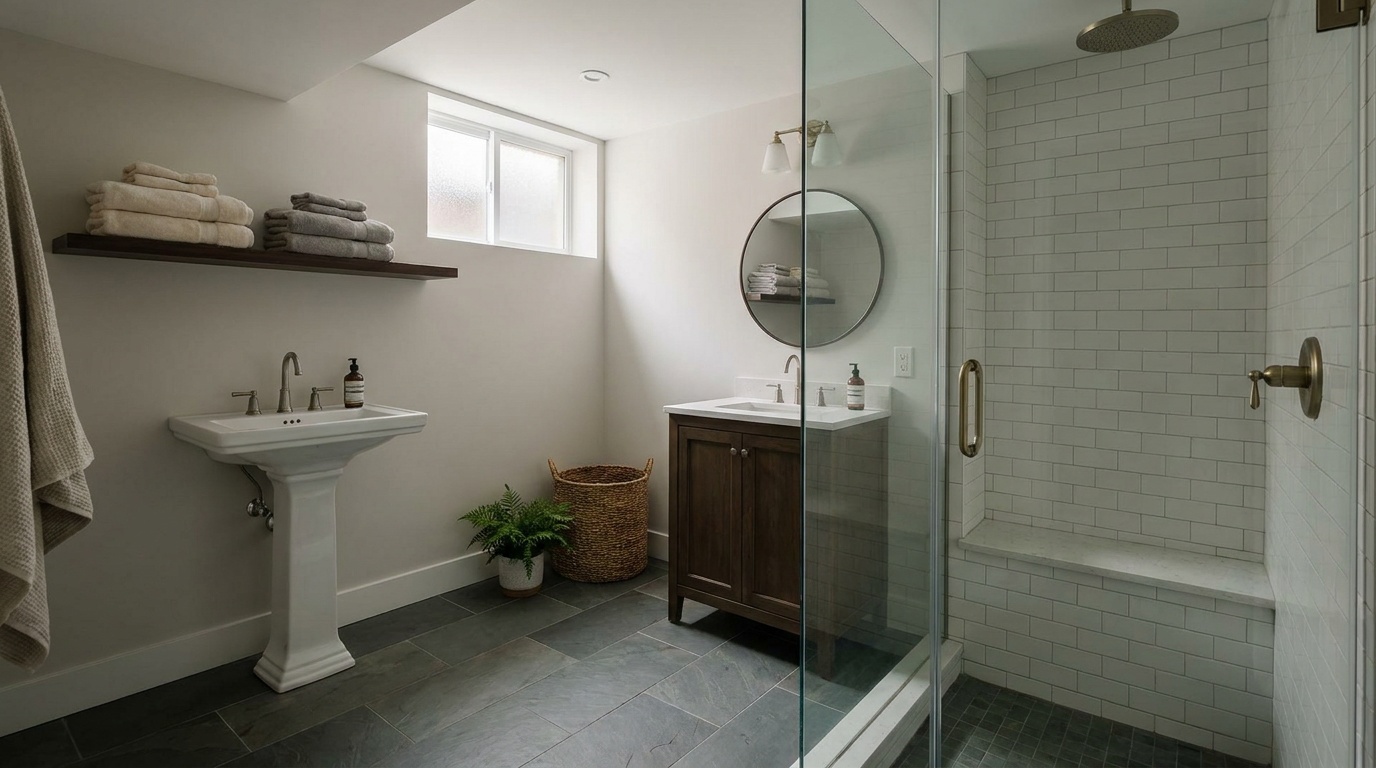
Basements near Lake Lanier and slab homes close to the square see grout cracking tied to moisture more often than framing issues. A musty smell or a cool, damp feel to the tile is worth checking before any repair.
Why Forsyth County Homes See This Pattern
Ranch homes built through the 80s and 90s near the square often sit on slab foundations that shift a little with the clay soil common in this part of Georgia. That shift telegraphs straight up through tile in a way it does not with a floating floor.
Newer construction south of downtown Cumming is framed over joists, typically spaced 16 inches on center. Those floors flex slightly under load, especially over longer spans. Tile installed without an isolation membrane over that kind of subfloor cracks sooner, sometimes within the first two to three years.
Basements near Lake Lanier and around the Sawnee Mountain area bring a third variable: humidity. Seasonal swings between roughly 30 and 60 percent relative humidity can soften thin-set over time, even where the slab itself looks fine on the surface.
Regrout, Repair, or Rebuild
If the crack pattern points to shrinkage only, regrouting is straightforward as a standalone repair. If it points to subfloor movement, regrouting alone will fail again within a season or two. The joint just reopens.
In kitchens and bathrooms, cracked grout is often the first visible sign of a bigger renovation decision. If the substrate needs leveling or the tile bed has failed across a wide area, it usually makes more sense to address it as part of a full kitchen remodel or bathroom remodel rather than chase individual cracks for years. Where hardwood is the better long-term fit for the room anyway, hardwood floor installation replaces the tile problem entirely instead of patching around it.
Either path starts the same way: an in-person look at the actual crack, the actual subfloor, and the actual moisture reading. Our estimates are free and itemized line by line, and scheduling is built around your timeline, not ours. For ballpark numbers across flooring types, the flooring cost guide is a good starting point before that visit.
If grout cracking has shown up in a kitchen, bathroom, or slab-level room anywhere across our service area, it is worth a second look before it becomes a bigger repair. Call (770) 906-4732 or request a free estimate at /contact/ and we will walk through what is actually happening under the tile.